If Your Co-Packer Is Stop-Start, So Is Your Growth
If you’ve scaled past your first co-packer, you already know this. Production doesn’t break loudly. It drifts.
Fill weights creep, changeovers stretch, schedules tighten, and deadlines are missed.
And suddenly, growth feels fragile. One of the fastest ways to assess whether a facility can stabilize that growth is to ask a simple question.
Is the line continuous motion, or stop-start?
Stop-Start Production Creates Variability
Traditional intermittent lines move product in segments:
Fill. Pause. Cap. Pause. Label. Pause.
For low-volume, thin products, that may work. For tomato-based sauces, condiments, and specialty products at scale, it introduces friction:
- Temperature fluctuation
- Mechanical stress on viscous product
- Inconsistent fill weights
- Slower throughput
Over time, those small inefficiencies compound into schedule pressure and quality drift.
That’s where continuous motion changes the equation.
What Continuous Motion Actually Does
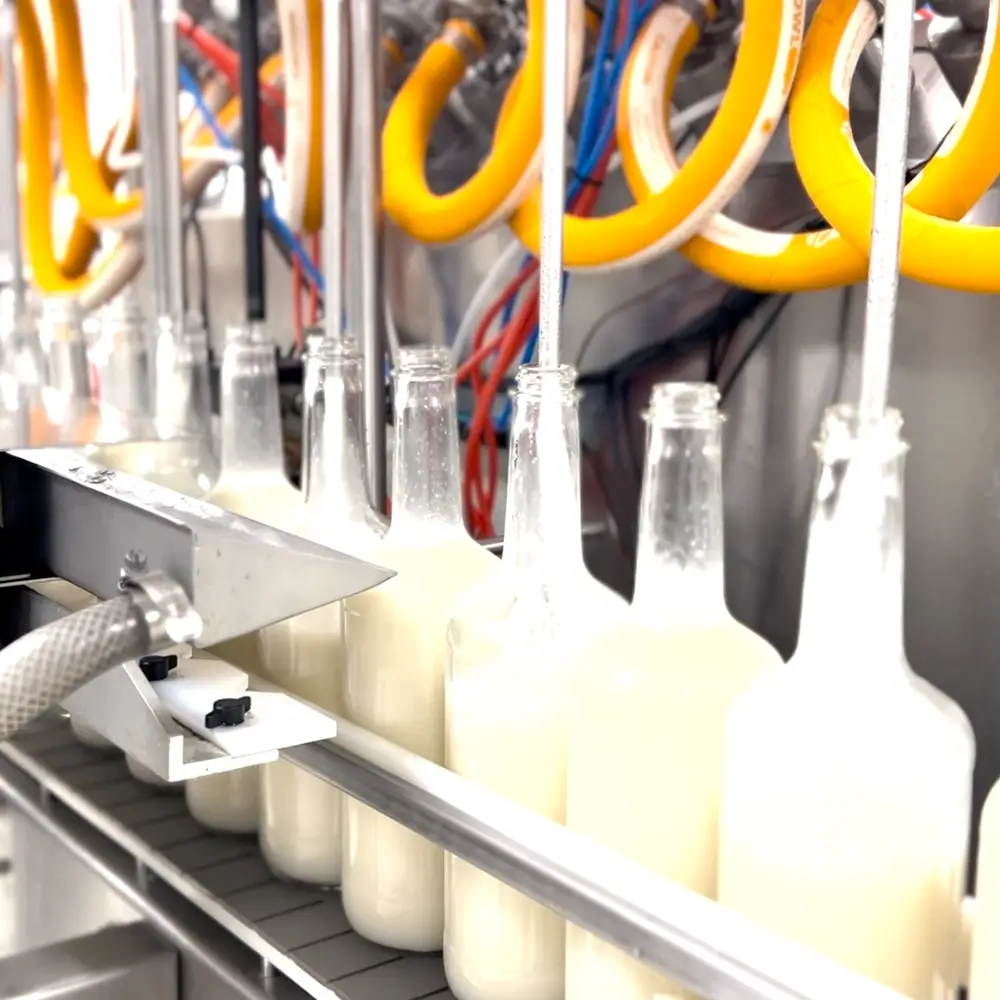
A continuous motion line moves product steadily from cook through fill and finish without interruption.
The benefits aren’t theoretical:
- More consistent temperature exposure
- Reduced product stress
- Smoother particulate handling
- Higher throughput stability
For tomato-based products (acidic, viscous, heat-sensitive) that steady flow protects flavor integrity and texture consistency.
Paired with internal heat exchange and automated controls, the system can detect when a run falls outside programmed specifications and correct it before it becomes a downstream issue.
That’s not just automation.
That’s risk reduction.
The Cost Conversation: Downtime and Throughput
Decision-makers care aboutcost, consistency, and reliability.
Continuous motion systems combined with automated CIP (clean-in-place) are widely recognized in food manufacturing for reducing cleaning and changeover time compared to manual or stop-start systems. Industry benchmarks show automated systems can reduce downtime by 20–50%, depending on configuration.
Less downtime means:
- Faster SKU changeovers
- More predictable production windows
- Lower labor drag per run
- Improved equipment effectiveness
Throughput also matters.
When evaluating line capability, experienced operators look at volume per minute, not just bottles per minute.
A line capable of processing approximately 400 gallons in 15 minutes (≈27 gallons per minute)* signals that production capacity won’t be the limiting factor as demand increases.For brands scaling from fragile growth to structured scale, that’s critical.
What it Means for your Brand
Continuous motion isn’t about having the biggest facility in the room. It’s about having the systems serious brands expect.
Because when growth accelerates, the line you choose either absorbs that pressure…or exposes it.